CoPulsationtm
Milking System
Welcome to the
world of dairy technology advancement.
Discover CoPulsationtm the first real advancement in
milking system technology in decades and understand why mastitis is caused
by the flawed design of conventional milking machines.
Discover Vacumizertm, the only variable speed vacuum
pump technology that does not cause stray voltage, does not
damage your pump/motor but does provide you with the energy savings you expect.
Pulse-Checktm, a simple hand-held and affordable
means of testing the function of your pulsators.
And finally, our
newest product – VacuTraxtm Vacuum
System Monitor. This patent pending product is the first and only such device
in the industry that continuously monitors the performance and health of you
vacuum pump and vacuum system.
Explore our
website further for more information that you will not find available at other
sources!
Continue below for more information.
Why haven’t the other companies made a better milking machine?
That is a common question we are often asked. Many
farmers don’t understand why the other companies have not improved their
milking machines when mastitis is still the most costly problem in the industry
and so many cows have slow quarters, uneven udders and mastitis. The fact of
the matter is that the other companies have been trying for many years to solve
these problems and have been unsuccessful in designing a milking system that
provides the performance of the CoPulsationtm Milking System.
Their attempts are documented in numerous patents
for products claiming to solve such
problems as liner crawl, incomplete milkout, teat irritation, and damage
to the teat/udder. You can read several examples of these on this site at the
Known Problems page. The companies that make conventional milking systems like
yours have actually documented the fact that your milking system causes these
problems! Wouldn’t it be nice if they had told you?
What makes your product different?
We are often asked what is different about our
product. Simply put, it is the only milking machine on the market that provides
a true massaging rest phase. All other systems provide a reduced milk phase in
the form of a pinching action of the liner. The CoPulsationtm Milking System removes the
vacuum from the teat canal and massages the full length of the teat thus
preventing the typical problems of liner crawl, pain, teat damage and
ultimately mastits.
How does it work?
The CoPulsationtm Milking System is unique in
that it requires two independent solenoids to control the fresh air and the
vacuum. One solenoid controls each as shown in detail below. This design
creates an extremely efficient pulsation action that causes the liner to open
and close differently than other milking systems. The liner fully closes below
the teat canal and it massages the full length of the teat. The massaging
action is very similar to the effect provided by support hose socks worn by
individuals with poor circulation in their legs. This liner action enables
proper blood and fluid flow in the teat during the rest phase so that the teat
is not swollen and reddened upon removal of the machine. Your milking systems
literally sucks continuously on the teat and canal throughout the milking
process causing swelling, liner crawl and the break down of the canal resulting
in scar tissue formation.
Do we back what we claim?
Absolutely!
We offer the only money-back performance guarantee in the industry.
The CoPulsationtm Milking System is guaranteed to fully pay for itself in less than two years through increased profits (reduced mastitis, increased production, increased butterfat, reduced cull rate). Typical paybacks are less than a year and a within a few months on larger herds.
No other company provides this performance guarantee!
Compare our pulsator design to the one you use:
The
internal design of our pulsator tells the story of why it performs differently
and is a revolutionary advance in the design of pulsators. View actual
photographs of pulsators below comparing the difference in internal
construction.
Our pulsator in the rest phase Our pulsator in the milk phase
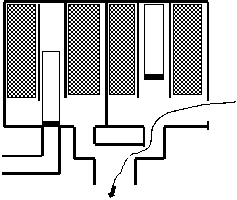
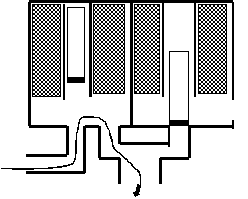
Our pulsator is a single phase, or 4X0 pulsator, but
it still has two solenoids. One solenoid is dedicated to the supply of the vacuum
(solenoid on the left above) for the milk phase and the other is dedicated to
the supply of the fresh air (solenoid on the right above) for the rest phase.
This provides for an extremely efficient control of air and vacuum that
is unmatched by any other pulsator in the world. This design makes it
completely impossible to ever have the fresh air and vacuum supplies mix
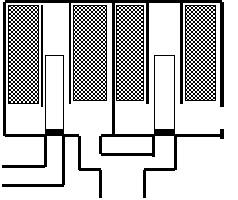
as all other pulsators do. The drawing below shows our pulsator in the
transition phase and demonstrates how it is impossible to have a mixing of air
and vacuum.
Our pulsator in
the transition phase
Now compare your pulsator design
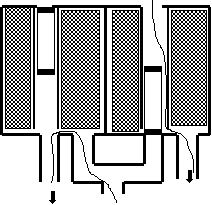
The drawing above shows the typical dual style (2X2)
pulsator. Each solenoid controls both the air and vacuum supply. In the drawing
above, the solenoid on the left is in the milk phase and the one on the right
is in the rest phase. Note that the supply of fresh air for your pulsator is
severely choked by the fact that the fresh air must force its way around the
piston because the piston is blocking the path for the fresh air. The drawing
below now shows the typical dual pulsator in the transition phase.
Your pulsator in the transition phase
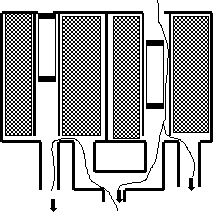
The
drawing above now shows more clearly why your pulsator provides such poor
performance. You will note that during the transition phase that both fresh air
and vacuum are mixing. This results in an extremely inefficient transition and
causes the liner to simply pinch the tip of the teat and fail to properly massage
the full length of the teat and also fail to stop the sucking action of the
milking vacuum. This leave you with nothing more than a degraded milk phase
instead of a true rest phase. You will also note another harmful defect in the
design of your dual pulsator. The fresh air that is mixing with the pulsator
half that is transitioning is also mixing with the other half of the pulsator
that is still in the milk phase. This mixing results in a liner pulse for the
two liners in the milk phase. This impact is sensed by the cows and disturbs
the milking for those two teats.
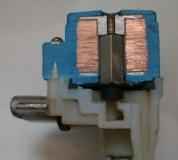
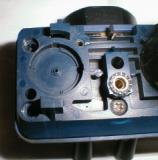
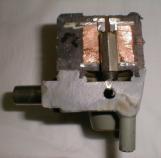
Photographs showing internal
construction of conventional pulsators.
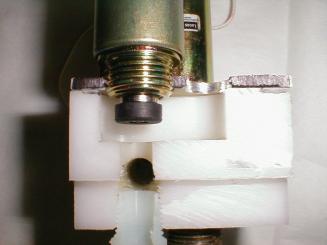
Note that each of these has an extremely restrictive fresh air
supply design that virtually chokes the flow of fresh air causing improper
liner action during their ”rest” phase. The Bou-Matic and Westfalia-Surge
pulsators require the fresh air to force its way between the plunger and the
coil windings. The DeLaval pulsator requires the fresh air to squeeze down a
very small pin sized hole.


Bou-Matic DeLaval Westfalia-Surge
Now
compare the large passage sizes in the CoPulsationtm Milking System pulsator.
The fresh air enters a large hole to the right of the solenoid and then travels
down to a large hole below the rubber tipped plunger. This design provides the
proper flow of fresh air to achieve a true massaging rest phase that actually
breaks the sucking action of the milking vacuum in the rest phase. The
conventional pulsators shown above simply destroy the teat canal and cause
mastitis.


CoPulsationtm
Milking System
Contents

Web Site Summary
Discover why conventional milking machines, like yours, don’t work and why mastitis is very profitable to everyone but the dairy farmer. Understand what our products are, how they work and how they will benefit you.
Independent data is provided
proving that the CoPulsationtm Milking System is superior.
University research has proven that a conventional milking system causes up to
15 times more new cases of mastitis than the CoPulsationtm
Milking System.
Data from the best 30 cows from a Cornell University herd
milked with a conventional milking system were found to have 24 cases of
mastitis proving the poor performance of a conventional milking system even
when the best management practices are followed!
DHI data from three Southern
university herds and one New England university herd and several California
university herds show that mastitis is a real problem with SCC levels
frequently in the 400,000 to 500,000 range. The data also shows that typical
cull rates are 40% to 50% in these herds even with their ideal conditions.


Teat condition following milking Teat condition following milking
with conventional system, note red with CoPulsationtm ,note
healthy
and swollen condition. Considered condition.
“normal” per Director of QMPS
at
Cornell University.
Don’t accept slow milking
quarters, incomplete milk outs with uneven udders and a herd of mostly first
and second calf heifers as the only way to milk cows!
Click on the links to the left for the
following:
CoPulsation Performance: Explains how the
CoPulsationtm
Milking System works and shows the system working.
Conventional Systems: Explains why conventional milking systems do not work well. Information from U.S. patent disclosures from companies that make conventional milking systems provides details of why cows do not milk well. The physics of milking machines and vacuum systems are discussed in simple terms detailing why many features of today’s milking facilities and equipment are poorly designed.
Consultants/Experts: A candid evaluation of the evolution of the dairy industry and the role that consultants and experts have played in the evaluation of dairy equipment.
Known Problems: A number of examples are provided of how the dairy industry knows, and has known for many years, that the milking system you milk with every day causes problems. Known design flaws are presented and discussed.
Why Mastitis?: A candid look at why cows get mastitis and why every farm has a problem, even the universities.
Company History
LR Gehm is a manufacturer of innovative dairy equipment products including the patented CoPulsationtm Milking System. The goal of LR Gehm is to provide dairy farmers with new technology that is superior to other available products. Each LR Gehm product is intended to enable the dairy farmer to increase profits and to pay for the product within two years or less.
LR Gehm was established in early 1995 following several years of developing and testing the CoPulsationtm Milking Sytem. The CoPulsationtm Milking System was developed on the dairy farm of Lanny Gehm after many frustrating years of experiencing mastitis problems and poor milk performance common with conventional milking systems. The milk quality, time to milk, udder health and teat condition of the cows on the farm improved dramatically with the introduction of the CoPulsationtm Milking System.
Since that time the CoPulsationtm
Milking System has received a U.S. Patent and many foreign patents. The product
has been marketed to dairy farmers throughout the U.S. and foreign countries.
Herd sizes range from less than 30 to commercial herds milking over 1000 cows
24 hours a day. Independent studies have proven that the system outperforms
conventional milking systems.
Products
LR
Gehm markets several products to dairy farmers.
CoPulsationtm Milking System
The first product marketed was the
CoPulsationtm Milking
System. That product is an innovative pulsation system that is the only product
in the world that provides a true massaging rest phase. This superior
performance provides a milking action that is second to none.
Vacumizertm Vacuum Pump Controller
This
product provides the dairy farmer with the desired energy savings and
efficiency of a variable speed vaccum
pump without the harmful effects of constant varying pump speed and
voltage fluctuations. This product avoids the stray voltage problems known to
be created by typical variable speed pump controllers.
Pulse-Checktm Pulsation Analyzer
This
product provides the dairy farmer with a simple and convenient means of
checking the performance of any brand of pulsator. This hand-held device is
simple and accurate.
VacuTraxtm Vacuum System Monitor
This
product provides the dairy farmer with a means of continuously monitoring the
health of the vacuum pump and total vacuum system. It also provides a digital
vacuum display for indication of the vacuum system vacuum level thereby serving
as a digital vacuum gauge. The monitor has a visual indicator as well as an
option for a remote located visual indicator for warning of a vacuum system
performance issue.
Contact Information
E-mail address
Office phone
607-849-3880
Mail Address
9502
NYS Rt. 79
Lisle,
New York 13797
USA
CoPulsation
is a trademark of LR Gehm, LLC
Vacumizer
is a trademark of LR Gehm, LLC
Pulse-Check
is a trademark of LR Gehm, LLC
VacuTrax
is a trademark of LR Gehm, LLC
Last revised: March 2005